
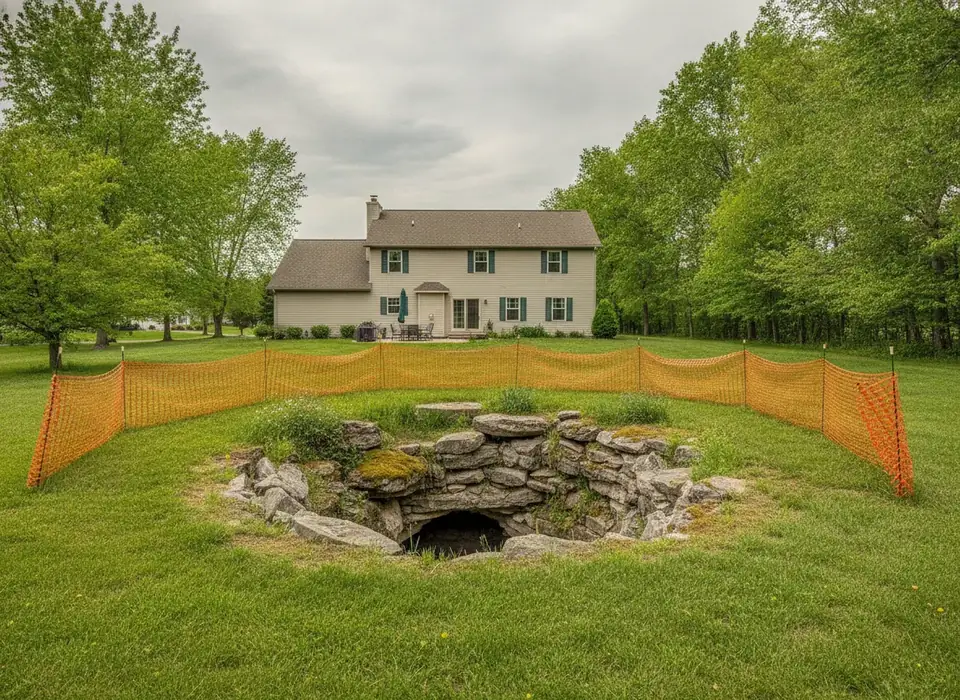
Bowling Green is well known for its karst. Most people here have heard of the Corvette Museum sinkhole, and plenty have watched the city fill a depression in a street or a neighbor's yard. But what does karst actually mean for a house, and how worried should a homeowner be? This guide sticks to what the Kentucky Geological Survey (KGS), the City of Bowling Green and local reporting have said, without the scare stories.
What is karst, and why is Bowling Green built on it?
Karst is landscape formed when water slowly dissolves soluble bedrock, usually limestone. Over thousands of years, that creates caves, underground streams, springs and sinkholes. KGS says more than half of Kentucky sits above karst terrain, and Warren County is a textbook example. KGS describes the lower part of the county as "a slightly rolling, karst (sinkhole) plain" characterized by few surface streams and "hundreds of sinkholes."
The city's stormwater program describes Warren County as "located in a karst region that is typified by caves, sinkholes, springs, underground streams." Much of the runoff in town "naturally flows down into the karst," which is why Bowling Green has so few surface streams. Rain that falls on a roof or a parking lot often ends up underground within hours.
The Lost River basin under the city
A large share of Bowling Green drains through the Lost River cave system, which carries water underground toward the Barren River. Lost River Cave is part of a roughly seven-mile system. A 2024 Western Kentucky University poster on the Lost River groundwater basin summed up its history as "two infamous sinkhole collapses, numerous cover collapses, significant sinkhole flooding." When heavy rain overwhelms that plumbing, water backs up and can pond in low spots, a problem called sinkhole flooding. Lost River Cave recorded its largest flood on record in April 2025.
City geologist Nick Lawhon has described it this way: "A karst aquifer is a lot like a set of pipes." When the pipes are full, the water has to go somewhere.
What happened in April 2025?
In early April 2025, Bowling Green got more than 10 inches of rain in four days. The city responded to at least 18 new sinkholes. Lawhon explained one reason the rain mattered so much: "When clay soil gets wet, it's heavier and it's more plastic." He also pointed out that depth to caves varies a lot across town, only 15–20 feet deep in parts of northwest Bowling Green near Russellville Road and Nashville Road, versus about 150 feet north of the river.
The repairs kept coming. In September 2025, a roughly 50-foot backyard sinkhole was filled with about 250 loads of rock. By March 2026, the city was on its third residential sinkhole repair of the year, at $90,000–$120,000. That followed a September 2024 case in the Briarwood neighborhood, where a 6-inch dip in the road led to a 20-foot excavation to find the opening in the rock.
The city's method, as reported, is to dig down to the bedrock "throat" of the sinkhole, then place geotextile fabric and graded crushed stone. It is a reminder that what shows at the surface is often the top of something deeper.
The 2014 Corvette Museum sinkhole
On February 12, 2014, a sinkhole about 40 feet across opened under the National Corvette Museum's Skydome, and eight Corvettes fell in. The floor gave way into a previously unknown cave. It is the most famous example, but it is not typical of what happens to houses. Far more common is slow movement.
Residual clay: the quieter problem
The soils across much of the area, such as the Pembroke and Crider series, are loess over limestone residuum. That residuum is the red clay left behind as limestone weathers. KGS notes that structures "partially supported on soft, residual clay soils" can "subside gradually, resulting in damage to the structure." In practice, that looks like slow settlement of one corner or one wall, not a sudden hole.
The clay also changes with the weather. It gets wetter and heavier in heavy rain and shrinks in drought. A house can move a little seasonally, and a gutter that dumps water at one corner for years can soften the clay right under a footing.
The KGS view: "Limestone terrain can be subject to subsidence hazards, which usually can be overcome by prior planning and site evaluation." Karst is a known condition here, and it is something engineers and contractors plan around every day.
What can homeowners watch for?
None of these signs proves a sinkhole. Many are ordinary settlement or drainage issues. They are worth noting, photographing and dating so you can show a professional how things changed.
- A new depression or soft spot in the yard, especially one that holds water or keeps growing.
- Water that disappears quickly into a hole after rain, or ponds where it never used to.
- New or widening cracks in foundation walls, brick veneer or drywall, especially stair-step cracks in block.
- Doors and windows that start to stick or gaps that open at the top of door frames.
- Floors that slope noticeably, or a gap between the floor and baseboard.
- Cracks in a driveway, patio or garage slab that keep spreading.
- Downspouts that discharge right next to the house.
For help reading cracks, see foundation crack types and when to worry. If you see a sinkhole on public land, in a street or tied to a stormwater structure, report it to Bowling Green Public Works Stormwater at 270-393-3628.
When should you call a professional engineer?
A foundation contractor's free evaluation is a sales estimate, not an engineering opinion. An engineer's report comes only from a Kentucky-licensed professional engineer (PE). Consider bringing in a PE, typically $300–$2,000 for a report, when:
- You see an opening or depression in the ground close to the foundation.
- Movement seems to be getting worse quickly.
- Two contractors recommend very different repairs.
- You are buying or selling and need an independent document.
- The house sits near a known sinkhole or a stormwater basin.
For ground loss, the engineer may also suggest a soil report ($1,000–$5,000) before any structural work. That information lets contractors quote the same scope.
What repairs are used on karst ground?
For a house that is settling, contractors commonly use steel push piers or helical piers driven to load-bearing material, sometimes paired with soil grouting or drainage changes. The right choice depends on depth to rock, the weight of the structure and what is causing the movement. The sinkhole and karst settlement repair page and the piers and house leveling page explain the options, and the cost guide lists typical national ranges.
Also check insurance early. Standard homeowners policies generally exclude earth movement, including sinkholes. See does insurance cover sinkholes in Kentucky?
Get local quotes
We connect Bowling Green-area homeowners with independent local foundation repair, crawl space and waterproofing companies for free, no-obligation quotes. If you are seeing movement, tell us what is going on and local companies can schedule a free evaluation and quote.