Piers & House Leveling in Bowling Green, KY

Sloping floors, stair-step cracks or doors that will not latch can mean a footing has settled. We connect Bowling Green-area homeowners with independent local foundation repair, crawl space and waterproofing companies for free, no-obligation quotes.

Get a Free Quote Call (727) 300-6656
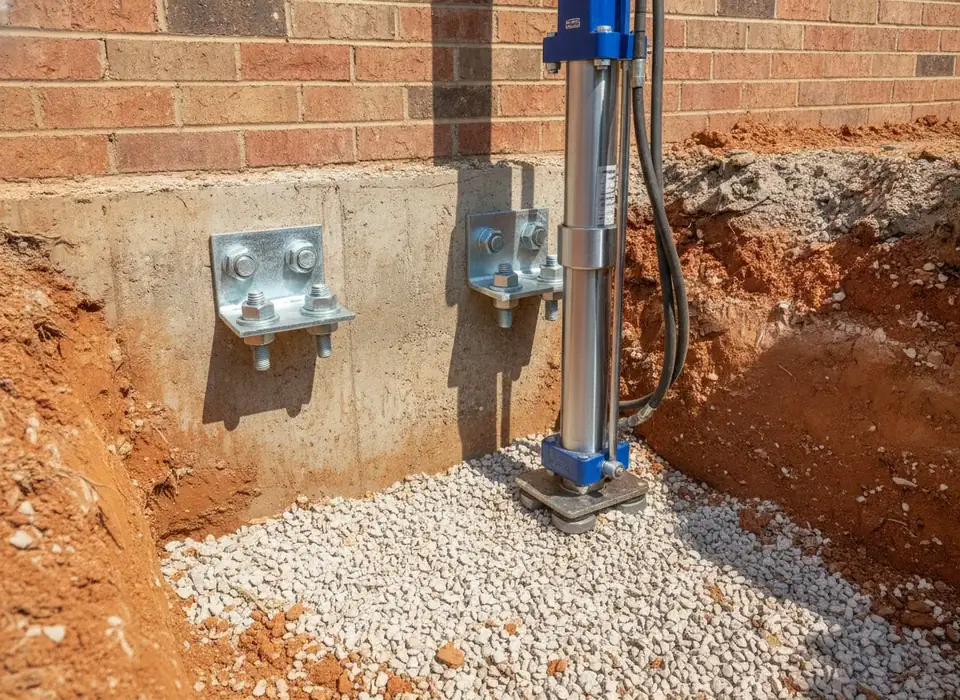
Steel pier bracket attached to a footing beside a brick home

What you are seeing: a settling footing

When one part of a foundation sinks more than the rest, the house tells you in several places at once. Stair-step cracks open in brick or block near one corner. Floors slope toward an outside wall. Doors on that side stick, and a chimney may lean away from the wall.

Piers are the structural answer when the soil under a footing can no longer carry the house. Steel piers are installed beside or beneath the footing, driven or screwed down to firmer soil or rock, and attached with brackets so the load of the house moves off the weak soil and onto the piers.

Push piers vs helical piers

Steel push piers

Sections of steel pipe are driven hydraulically, using the weight of the house as the reaction, until they reach firm bearing. Each pier is load-tested as it goes. Typical installed cost is $1,000–$3,000 each nationally; one national installer lists $990–$1,350. Suited to structures heavy enough to drive them.

Helical piers

Steel shafts with screw-like plates are turned into the ground with a hydraulic torque motor, and the installation torque indicates capacity. Typical installed cost is about $3,500–$4,400 each. Often used for lighter structures such as porches, additions or decks, or where a push pier cannot develop enough load.

Our blog post on push piers vs helical piers compares them in more depth.

Depth to limestone in karst ground

Bowling Green's geology makes pier depth genuinely variable. City geologist Nick Lawhon told Louisville Public Media in April 2025 that caves sit only 15–20 feet deep in northwest Bowling Green, around Russellville Road and Nashville Road, compared with about 150 feet north of the river. In March 2026 he told WBKO that “Bowling Green sits on top of thick limestone bedrock.” Above that rock is red clay residuum, which the Kentucky Geological Survey says can “subside gradually” under structures partly supported on it.

In practice that means two neighbors can get very different pier depths, and the depth on one corner of a house can differ from the other. Ask each company to log the final depth and the load or torque reached at every pier, and to give you that log when the job is done.

If your house sits near a known sinkhole or depression, read our sinkhole and settlement page first. Settlement near karst features usually calls for a Kentucky-licensed professional engineer and possibly deeper piers to rock.

House leveling: what the companies do

  1. Survey elevations

    A laser level maps how far each part of the floor has dropped. The free evaluation is a sales estimate, not an engineering opinion.

  2. Lay out the piers

    The quote sets pier type, count and spacing along the settled section, sometimes after an engineer's design.

  3. Excavate and bracket

    Soil is dug away beside the footing, the footing is prepared and steel brackets are attached.

  4. Install and load-test

    Piers are driven or screwed to firm bearing, with depth and load recorded for each.

  5. Lift, lock and backfill

    The house is lifted together across the piers, locked off and the excavation backfilled.

Lifting can crack finishes; ask how the company handles that. The quote process page covers what happens between first call and signed contract.

Why this matters in Bowling Green

The Kentucky Geological Survey describes Warren County's lower part as a karst plain with hundreds of sinkholes, and adds that “Limestone terrain can be subject to subsidence hazards, which usually can be overcome by prior planning and site evaluation.” Bowling Green's median home was built in 1991 and about 38% of units date from 2000 or later (ACS 2020–24), so many settlement calls involve fairly young homes on clay fill as well as older ranches.

What piers and leveling cost

ItemTypical range
Steel push pier, installed$1,000–$3,000 each (one national installer lists $990–$1,350)
Helical pier, installedabout $3,500–$4,400 each
Underpinning project$10,000–$40,000 (5–15 piers is common)
Structural engineer's report$300–$2,000; soil report $1,000–$5,000

Typical national ranges (Fixr 2026, This Old House 2026, a national installer's published list) — estimates, not quotes.

More detail is in the foundation repair cost guide. Ask for the warranty in writing: term, what voids it, whether it transfers to a buyer and any transfer fee.

Before you sign

Licensing, permits and your right to cancel

Kentucky has no statewide general-contractor license (the state licenses trades like electrical, plumbing and HVAC). In Bowling Green and Warren County, the Bowling Green–Warren County Contractors Licensing Board requires any general or specialty contractor to be licensed, on a 12-month license with proof of liability insurance and workers' comp/UI compliance. Homeowners can check a company on the board's Active Contractor Search at bgky.org. Ask for the company's Bowling Green–Warren County contractor license and look it up before signing. Outside Warren County (Glasgow, Franklin, Russellville, Scottsville, Morgantown), licensing is handled locally; ask the city or county building office.

Bowling Green's Building Division (Neighborhood & Community Services) requires a permit to “construct, enlarge, alter, repair or demolish a structure.” Foundation repair isn't named on the page, so ask whether your job needs a permit — structural work usually does; the contractor normally pulls it.

Under Kentucky's home solicitation sales law (KRS 367.410–.460), a buyer can generally cancel a contract signed at home until midnight of the third business day, and the seller must provide a “BUYER'S RIGHT TO CANCEL” notice; there is an emergency-repair exception. This is general information, not legal advice.

Piers and house leveling FAQs

Push piers vs helical piers: which is better on Bowling Green limestone?

It depends on the load and the ground. Push piers use the weight of the house to drive steel pipe down until it reaches firm bearing, which in much of Bowling Green may be limestone. Helical piers are screwed in and suit lighter loads or porches where there is not enough weight to drive a push pier. Many quotes use both. Ask why each was chosen.

How deep do piers go in Bowling Green?

There is no single number. Depth to firm bearing or rock changes from lot to lot in karst. City geologist Nick Lawhon has said caves sit only 15 to 20 feet deep in northwest Bowling Green, near Russellville Road and Nashville Road, versus about 150 feet north of the river. Ask the contractor to record the final depth and load of every pier.

How many piers does a house need?

It depends on how much of the foundation is settling and how heavy that section is. Five to 15 piers is common for an underpinning job, according to national installer data, and full underpinning projects run about $10,000 to $40,000. Compare quotes by pier spacing, pier type and installed depth, not just the total.

Can a house be lifted all the way back to level?

Sometimes, but not always, and contractors should say so before work starts. Lifting is limited by what the structure can tolerate: brick veneer, plaster, plumbing and doors may crack or bind if pushed too far. Ask what lift they expect and what happens to interior finishes.

Do I need an engineer before getting piers?

Not always, but it is wise when quotes disagree, the house is near a sinkhole, or you are buying or selling. A contractor's free evaluation is a sales estimate. A Kentucky-licensed professional engineer gives an independent opinion and can specify the repair. Engineer's reports typically run $300 to $2,000 nationally, with soil reports $1,000 to $5,000.

Get free pier and house leveling quotes

Describe the cracks, sloping floors or sticking doors, and which side of the house they are on. We pass your request to independent local companies serving Bowling Green and Warren County, and we usually reply the same day.

No obligation. We reply fast — usually same day.

Related guides

Cracks, sticking doors or a sloping floor? Get free foundation quotes.

Free, no-pressure quotes from independent companies across Bowling Green, Warren County and South Central Kentucky.

Call NowFree Quote