
Mudjacking (slabjacking)
The contractor drills holes through the slab and pumps a cement-based slurry underneath until the slab rises. It is the older, usually cheaper method, about $500–$1,900 nationally.
Sunken garage floor, cracked slab or a driveway that tips toward the house? We connect Bowling Green-area homeowners with independent local foundation repair, crawl space and waterproofing companies for free, no-obligation quotes.
Get a Free Quote Call (727) 300-6656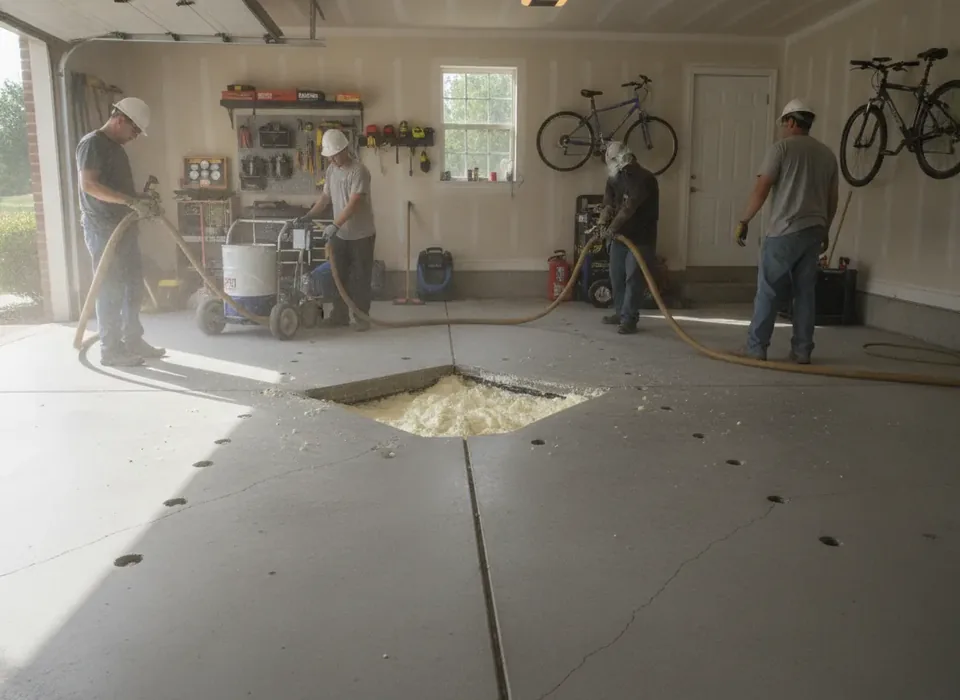
Concrete slabs show settlement in a few familiar ways. A garage floor develops a crack and one side sits lower than the other. A patio tilts back toward the house so rain pools against the wall. A driveway panel drops at the joint and becomes a trip edge. Inside, a slab home may show floor cracks or doors that no longer latch.
The cause is nearly always the soil under the concrete rather than the concrete itself. Soil compacts, washes out or shrinks, and the slab follows it down. The repair question is whether you are dealing with flat work (garage floors, driveways, patios, walks) that can be lifted back into place, or with the foundation that carries the house, which may need deeper support.
The contractor drills holes through the slab and pumps a cement-based slurry underneath until the slab rises. It is the older, usually cheaper method, about $500–$1,900 nationally.
Smaller holes, a two-part foam that expands under the slab, and a slab that can often be used the same day. National guides put it at roughly $5–$15 per square foot and disagree with each other, so compare written quotes. Foam is lighter, which matters on soft clay.
Either way, ask what is causing the drop. If water keeps scouring soil from under a patio, lifting it without fixing the drainage just resets the clock. If the slab is part of the foundation and the footing is settling, the right quote may be piers and house leveling instead.
Garage floors often crack where the floor meets the foundation wall, and the outer edge drops as fill settles. Driveways settle at control joints and where they meet the garage apron, sending water back toward the house. Patios and walks tilt when downspouts or gutter overflow wash out the soil beside them.
Slab work on fresh fill is a local theme too. After the December 11, 2021 high-end EF-3 tornado (NWS Louisville), which damaged or destroyed roughly 500 Warren County homes according to Gov. Beshear, many homes were rebuilt or repaired, sometimes with new slabs on new fill. Fill that was not fully compacted can settle in the first years afterward, so a slab that drops on a rebuilt lot is worth having evaluated.
The contractor checks elevations, crack locations and where water drains. A free evaluation is a sales estimate, not an engineering opinion.
Flat work is lifted; a settling footing may need piers.
Holes are drilled in a pattern, material is pumped under the slab and the lift is watched closely.
Holes are patched, joints and cracks sealed, and downspouts or grading addressed so the soil stays put.
See how the free quote process works from first call to signed contract.
Common local soils such as the Pembroke and Crider series are loess over limestone residuum (USDA soil series descriptions). That red clay is wetter and heavier in long rains and shrinks in drought, so slabs on it move with the seasons. The Kentucky Geological Survey also notes that in Warren County's karst plain, stormwater “can flow underground through large solution channels.” A slab that sinks in one tight spot, especially after heavy rain, may be telling you something about the ground below. Our sinkhole and settlement page explains when that calls for a professional engineer before anyone lifts or fills.
| Item | Typical range |
|---|---|
| Mudjacking / slabjacking | $500–$1,900 |
| Polyurethane foam leveling | about $5–$15 per sq ft (guides disagree) |
| Foundation repair, overall project | $2,200–$8,200 (national average about $5,200) |
| Steel push pier, installed | $1,000–$3,000 each |
Typical national ranges (Fixr 2026, This Old House 2026, a national installer's published list) — estimates, not quotes.
The foundation repair cost guide breaks down every repair type. Ask for the warranty in writing: term, what voids it, whether it transfers to a buyer and any transfer fee.
Kentucky has no statewide general-contractor license (the state licenses trades like electrical, plumbing and HVAC). In Bowling Green and Warren County, the Bowling Green–Warren County Contractors Licensing Board requires any general or specialty contractor to be licensed, on a 12-month license with proof of liability insurance and workers' comp/UI compliance. Homeowners can check a company on the board's Active Contractor Search at bgky.org. Ask for the company's Bowling Green–Warren County contractor license and look it up before signing. Outside Warren County (Glasgow, Franklin, Russellville, Scottsville, Morgantown), licensing is handled locally; ask the city or county building office.
Bowling Green's Building Division (Neighborhood & Community Services) requires a permit to “construct, enlarge, alter, repair or demolish a structure.” Foundation repair isn't named on the page, so ask whether your job needs a permit — structural work usually does; the contractor normally pulls it.
Under Kentucky's home solicitation sales law (KRS 367.410–.460), a buyer can generally cancel a contract signed at home until midnight of the third business day, and the seller must provide a “BUYER'S RIGHT TO CANCEL” notice; there is an emergency-repair exception. This is general information, not legal advice.
Both lift a settled slab by pumping material underneath. Mudjacking uses a cement-based slurry through larger holes and typically costs $500 to $1,900 nationally. Foam uses smaller holes, is lighter and cures quickly, at roughly $5 to $15 per square foot, though guides disagree. Ask each company what is causing the drop.
Concrete leveling lifts flat work that has sunk, such as a garage floor, driveway, patio, walkway or porch slab. Concrete foundation repair deals with the part that carries the house: the footing, the slab-on-grade under living space, or the foundation walls. A sunken garage slab is usually leveling; a cracked slab under the kitchen with sloping floors often needs piers or slab piers.
Most slabs sink because the soil under them settles, washes out or was poorly compacted. Bowling Green's red clay over limestone holds water in long rains and shrinks in drought, and downspouts that dump next to a slab can carry soil away. In karst areas, a slab that sinks suddenly in one spot deserves a closer look before anyone simply fills it.
Foam can work well where the soil underneath has settled and stabilized. It is less suited where water keeps eroding the base or where the ground is still dropping. Ask the contractor how they plan to deal with drainage, what warranty they offer in writing, and what voids it. If the slab carries the house, ask whether piers would be more appropriate.
Sometimes. Interior slabs that have dropped evenly can be lifted with foam or slurry. When the footing around the edge has settled, or the slab cracks and keeps moving, contractors usually quote piers to carry the load to firmer soil or rock. A Kentucky-licensed professional engineer can give an independent opinion when quotes disagree.
Tell us what has sunk, roughly how big it is and when you noticed it. We pass your request to independent local companies serving Bowling Green, Warren County and South Central Kentucky, and we usually reply the same day.
Hairline, stair-step and horizontal cracks, and when injection makes sense.
Push and helical piers for a settling footing or house slab.
Typical national ranges for leveling, piers and more.
Free, no-pressure quotes from independent companies across Bowling Green, Warren County and South Central Kentucky.