
Hairline cracks
Thin, straight, often vertical in poured concrete. Usually shrinkage; monitor them and seal if water comes through.
A new crack in a basement wall, slab or brick veneer is worth a closer look. We connect Bowling Green-area homeowners with independent local foundation repair, crawl space and waterproofing companies for free, no-obligation quotes.
Get a Free Quote Call (727) 300-6656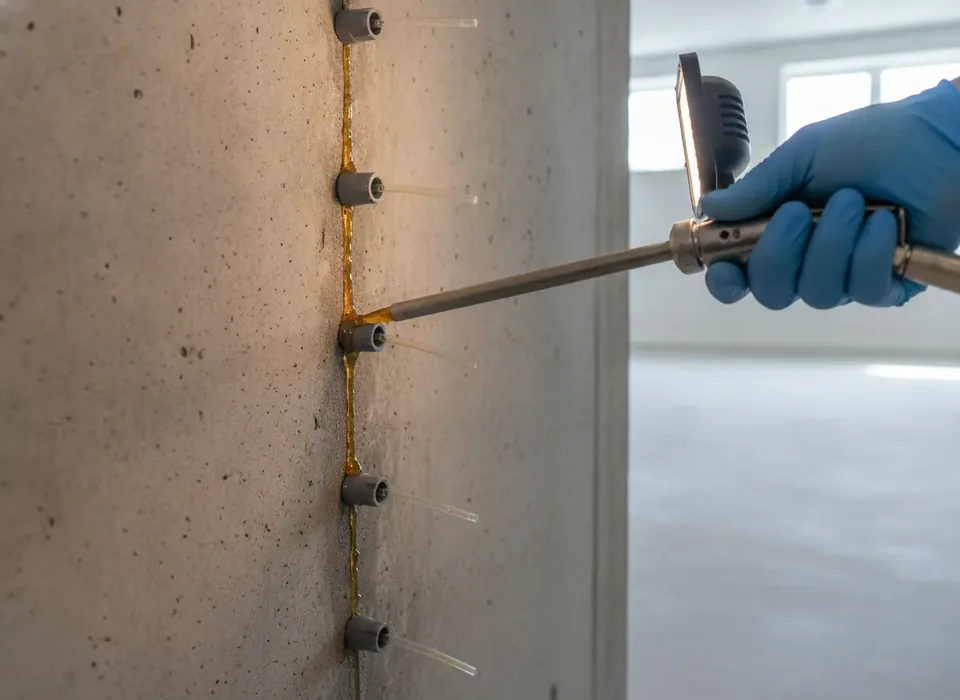
Almost every house develops a few cracks. The useful questions are what kind of crack it is, what the wall is built from, and whether it is still moving.
Poured concrete walls and slabs. Concrete shrinks as it cures, so thin, roughly vertical hairline cracks are common in poured walls and garage or basement slabs. Hairline and dry, they are often cosmetic. When a poured-wall crack leaks, widens, or is noticeably wider at the top than the bottom, it is telling you something about water or movement.
Concrete block walls. Block walls crack along the mortar joints. A stair-step crack that zigzags up through the joints usually tracks settlement at one corner or along one side of the house. A horizontal crack running along a block wall, often a few courses below grade, is the pattern most associated with soil pushing the wall inward. More on our bowing basement wall repair page.
Thin, straight, often vertical in poured concrete. Usually shrinkage; monitor them and seal if water comes through.
Zigzag through block or brick mortar joints. Often linked to one part of the foundation settling more than another. Sloping floors and sticking doors nearby point to a cause underneath.
Run along a block or poured wall below grade. Associated with lateral soil and water pressure. Have these evaluated promptly, especially if the wall leans or bows.
One simple habit helps any evaluator: mark both ends of the crack with a pencil, write the date beside it, and take a photo with a ruler. Our guide to crack types and when to worry goes further.
The contractor checks wall type, crack pattern, moisture and settlement signs. A free evaluation is a sales estimate, not an engineering opinion.
Epoxy for bonding a poured wall back together; flexible polyurethane foam for stopping water; tuckpointing or reinforcement for block.
The crack is cleaned, surface-sealed, and small injection ports are set along its length, as in the photo above.
Resin is pumped in from the bottom port up until it fills the crack through the wall thickness.
Ports come off once cured. Ask for photos and written warranty terms.
Injection seals a crack; it does not stop a foundation that is still settling or a wall that is still being pushed in. If the evaluation points to movement, expect the quote to include piers or house leveling or wall reinforcement as well, and see how the quote process works.
Bowling Green sits in Kentucky karst country. The Kentucky Geological Survey describes the lower part of Warren County as “a slightly rolling, karst (sinkhole) plain” with hundreds of sinkholes, and notes that structures partly supported on soft residual clay can “subside gradually, resulting in damage to the structure.” Common local soils (Pembroke, Crider) are loess over limestone residuum (USDA). That red clay residuum gets wetter and heavier in long rains and shrinks in drought, which is exactly the kind of seasonal push and pull that opens cracks.
Water is the other half of the story. After more than 10 inches of rain in four days in April 2025, city geologist Nick Lawhon told Louisville Public Media, “When clay soil gets wet, it's heavier and it's more plastic.”
Slab, crawl space and basement homes are all built here; about 28% of Bowling Green's housing units date from 1950–79 (ACS 2020–24).
| Item | Typical range |
|---|---|
| Crack sealing / epoxy or polyurethane injection | $200–$1,000 per crack |
| Foundation repair, overall project | $2,200–$8,200 (national average about $5,200) |
| Structural engineer's report | $300–$2,000 |
Typical national ranges (Fixr 2026, This Old House 2026, a national installer's published list) — estimates, not quotes.
See the full foundation repair cost guide for every repair type. Ask for the warranty in writing: term, what voids it, whether it transfers to a buyer and any transfer fee.
Kentucky has no statewide general-contractor license (the state licenses trades like electrical, plumbing and HVAC). In Bowling Green and Warren County, the Bowling Green–Warren County Contractors Licensing Board requires any general or specialty contractor to be licensed, on a 12-month license with proof of liability insurance and workers' comp/UI compliance. Homeowners can check a company on the board's Active Contractor Search at bgky.org. Ask for the company's Bowling Green–Warren County contractor license and look it up before signing. Outside Warren County (Glasgow, Franklin, Russellville, Scottsville, Morgantown), licensing is handled locally; ask the city or county building office.
Bowling Green's Building Division (Neighborhood & Community Services) requires a permit to “construct, enlarge, alter, repair or demolish a structure.” Foundation repair isn't named on the page, so ask whether your job needs a permit — structural work usually does; the contractor normally pulls it.
Under Kentucky's home solicitation sales law (KRS 367.410–.460), a buyer can generally cancel a contract signed at home until midnight of the third business day, and the seller must provide a “BUYER'S RIGHT TO CANCEL” notice; there is an emergency-repair exception. This is general information, not legal advice.
Pattern and movement matter more than length. A thin, straight vertical crack in a poured wall is often shrinkage. Stair-step cracks in block, cracks wider at one end, horizontal cracks, or cracks paired with sticking doors and sloping floors point to movement. Mark and date the ends; if it grows, get a contractor's evaluation or a Kentucky-licensed professional engineer's opinion.
Epoxy is rigid and is used when the goal is to bond a poured-concrete wall back together. Polyurethane foam stays flexible and expands, so it is used mainly to stop water coming through a crack. Neither is designed to stop a wall that is still moving; that needs the cause addressed first, such as settlement or soil pressure.
Usually not in the same way. Injection works on solid poured walls, where the material can fill the crack from face to face. Block walls are hollow, so injected material can disappear into the cores. Block cracks are more often treated by tuckpointing, wall reinforcement such as carbon fiber or anchors, or addressing the settlement underneath, depending on what the evaluation finds.
Typical national ranges put crack sealing and epoxy or polyurethane injection at about $200 to $1,000 per crack (Fixr 2026, This Old House 2026). Those are estimates, not quotes. Comparing two or three written quotes is the most reliable way to see what a Bowling Green job costs.
Bowling Green's Building Division requires a permit to construct, enlarge, alter, repair or demolish a structure. Foundation repair isn't named specifically, so ask whether your job needs a permit. Structural work usually does, and the contractor normally pulls the permit.
Tell us where the crack is and whether it leaks. We pass your request to independent local companies serving Bowling Green and Warren County, and we usually reply the same day. There is no cost and no obligation.
When cracks come from settlement, piers are the usual structural fix.
Horizontal cracks, anchors, braces and carbon fiber.
Typical ranges for every repair type, with what moves the price.
Free, no-pressure quotes from independent companies across Bowling Green, Warren County and South Central Kentucky.