
Carbon fiber strips
High-strength strips are epoxied vertically to the wall face, anchored at the top and bottom. Low profile and quick to install, they suit walls with modest bowing. About $4,000–$12,000 nationally for roughly 12 strips.
A horizontal crack or a basement wall that leans in at the middle is worth an evaluation. We connect Bowling Green-area homeowners with independent local foundation repair, crawl space and waterproofing companies for free, no-obligation quotes.
Get a Free Quote Call (727) 300-6656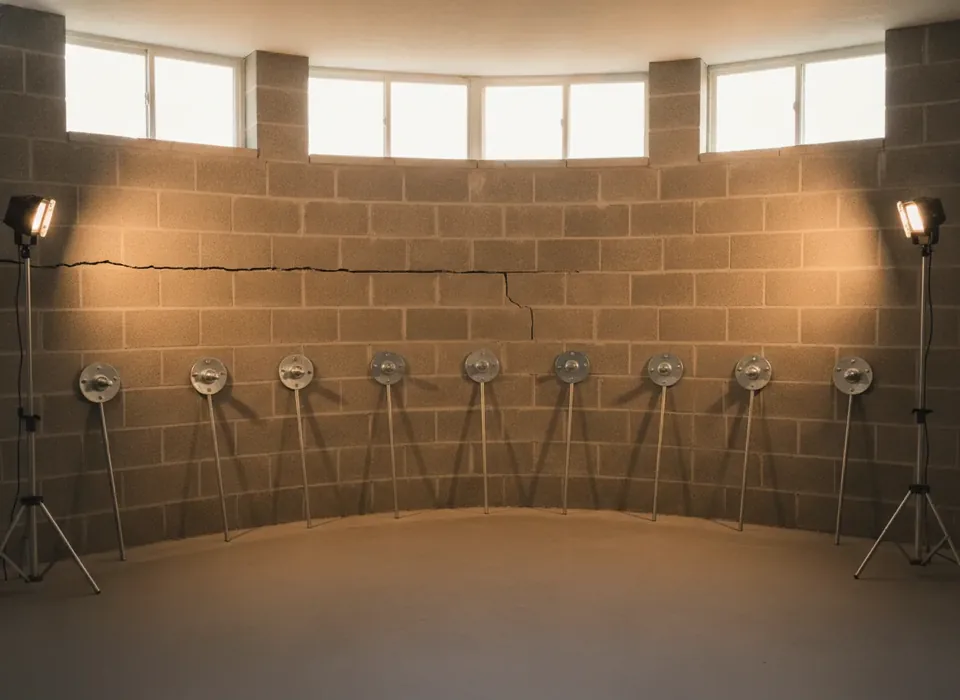
Basement and below-grade walls hold back soil. When that soil is wet and heavy, or freezes against the wall, it pushes harder than the wall was built for, and the wall starts to give. On a concrete block wall the first sign is often a horizontal crack along a mortar joint, a few courses below the outside grade. Over time the middle of the wall bows inward, blocks may shift, and stair-step cracks can appear at the ends.
Poured walls can bow too, usually with a horizontal or diagonal crack and a wall that leans in at the top. Other clues: a gap between the top of the wall and the floor framing, efflorescence (white mineral deposits) along a crack line, and water seeping in at the bow.
A simple check helps: hold a long level or a taut string against the wall and measure the deepest point of the bow. Write it down with the date. A contractor or engineer will ask whether the wall is still moving, and you will have the answer.
High-strength strips are epoxied vertically to the wall face, anchored at the top and bottom. Low profile and quick to install, they suit walls with modest bowing. About $4,000–$12,000 nationally for roughly 12 strips.
A rod runs through the wall to an earth anchor plate buried in the yard, with a plate on the inside face. Tightened over time, anchors can stabilize and sometimes slowly straighten a wall. They need yard access.
Vertical steel beams are fixed to the floor and to the joists above, holding the wall in place from inside. No yard digging, but they take up a little basement space. Anchors and braces run about $5,000–$15,000 nationally.
Where a wall has moved too far, quotes may instead include excavating outside to straighten or rebuild the wall. Horizontal cracks are also covered on our foundation crack repair page.
The contractor measures bow and lean, notes crack patterns and checks outside grading and gutters. A free evaluation is a sales estimate, not an engineering opinion.
Carbon fiber, anchors, braces or rebuilding, based on how far the wall has moved and site access.
Strips are bonded, anchors set and tensioned, or braces fixed to floor and framing.
Downspouts, grading or an interior drain reduce the soil pressure that caused the bow.
Anchors may be re-tightened over time; ask for a schedule in writing.
The soil around a Bowling Green basement is a large part of the story. The area's common Pembroke and Crider soils are loess over limestone residuum (USDA), and that red clay is heavier when wet. As city geologist Nick Lawhon put it during the April 2025 storms, “When clay soil gets wet, it's heavier and it's more plastic” (Louisville Public Media). More than 10 inches of rain fell in four days that month. Saturated, heavy clay against a block wall is exactly the load that opens horizontal cracks.
Basements are one of three foundation types built here, alongside slab and crawl space homes, and many older basements are block. About 28% of Bowling Green's housing units were built between 1950 and 1979 (ACS 2020–24 5-year estimates). If your block basement has started to bow, a wall that also leaks may need basement waterproofing in the same project.
| Item | Typical range |
|---|---|
| Bowing wall: carbon fiber | $4,000–$12,000 (about 12 strips) |
| Bowing wall: anchors or braces | $5,000–$15,000 |
| Structural engineer's report | $300–$2,000 |
Typical national ranges (Fixr 2026, This Old House 2026, a national installer's published list) — estimates, not quotes.
The foundation repair cost guide has the full table. Ask for the warranty in writing: term, what voids it, whether it transfers to a buyer and any transfer fee.
Kentucky has no statewide general-contractor license (the state licenses trades like electrical, plumbing and HVAC). In Bowling Green and Warren County, the Bowling Green–Warren County Contractors Licensing Board requires any general or specialty contractor to be licensed, on a 12-month license with proof of liability insurance and workers' comp/UI compliance. Homeowners can check a company on the board's Active Contractor Search at bgky.org. Ask for the company's Bowling Green–Warren County contractor license and look it up before signing. Outside Warren County (Glasgow, Franklin, Russellville, Scottsville, Morgantown), licensing is handled locally; ask the city or county building office.
Bowling Green's Building Division (Neighborhood & Community Services) requires a permit to “construct, enlarge, alter, repair or demolish a structure.” Foundation repair isn't named on the page, so ask whether your job needs a permit — structural work usually does; the contractor normally pulls it.
Under Kentucky's home solicitation sales law (KRS 367.410–.460), a buyer can generally cancel a contract signed at home until midnight of the third business day, and the seller must provide a “BUYER'S RIGHT TO CANCEL” notice; there is an emergency-repair exception. This is general information, not legal advice.
They deserve prompt attention. A horizontal crack in a block or poured basement wall is the pattern most associated with soil and water pushing the wall inward. On its own it does not tell you how fast the wall is moving. Measure the bow, photograph it with a level, and get an evaluation. If the wall is moving quickly, ask a Kentucky-licensed professional engineer.
Carbon fiber strips are epoxied to the wall face to stop further bowing on walls with modest movement. Wall anchors run through the wall to plates buried in the yard and can be tightened over time. Steel I-beam braces stand against the wall from floor to joists and need no yard digging. Each suits different amounts of bow and different site access.
Typical national ranges put carbon fiber at about $4,000 to $12,000 for around 12 strips, and wall anchors or braces at about $5,000 to $15,000 (Fixr, This Old House, a national installer's published list). These are estimates, not quotes. Wall length, how far it has moved, finished space and yard access all affect the price, so compare written quotes line by line.
Sometimes, partly. Wall anchors can be tightened gradually over seasons to pull a wall back toward plumb, and some contractors excavate the outside to straighten a wall before bracing. Carbon fiber and braces mainly stop further movement. Ask each company whether its method is meant to stabilize or straighten, and how much recovery it expects.
It helps, because wet, heavy soil pushes harder on a wall. Extending downspouts, regrading so water runs away from the house and keeping an interior drain working all reduce pressure. Drainage alone will not reverse a bow that has already happened, but most wall reinforcement quotes include or recommend it so the fix is not fighting the same water.
Tell us which wall is affected, what it is made of and roughly how far it bows. We pass your request to independent local companies serving Bowling Green and South Central Kentucky, and we usually reply the same day.
Reading hairline, stair-step and horizontal cracks.
Drains and sumps that take pressure off basement walls.
Carbon fiber, anchor and brace ranges side by side.
Free, no-pressure quotes from independent companies across Bowling Green, Warren County and South Central Kentucky.